Highlights
|
Purpose
The prevalence of myopia is increasing worldwide, stimulating interest in methods to slow its progression. The primary rationale for slowing the progression of myopia is to reduce the risk of vision loss through sight-threatening ocular pathological features in adulthood.
The article examines whether the potential benefits of slowing myopia progression by 1 diopter (D) justify the potential risks associated with the treatments.
Methods
First, the known risks associated with various methods of myopia control are summarized, with emphasis on contact lens use. Based on available data, the risk of visual impairment and expected years of visual impairment are estimated for a variety of incidence levels. Below we review the increased risk of life-threatening eye conditions associated with different levels of myopia.
Finally, a model of the risk of visual impairment as a function of myopia level is developed, and the years of visual impairment associated with various levels of myopia and the years of visual impairment that could be prevented with achievable levels of myopia control are estimated.
Results
Assuming an incidence of microbial keratitis between 1 and 25 per 10,000 patient-years and that 15% of cases result in vision loss leads to the conclusion that between 38 and 945 patients need to be exposed to 5 years of use to produce 5 years of vision loss.
Each additional 1 D of myopia is associated with a 58%, 20%, 21%, and 30% increase in the risk of myopic maculopathy, open-angle glaucoma, posterior subcapsular cataract, and retinal detachment, respectively.
The expected mean number of years of visual impairment ranges from 4.42 in a person with –3 D myopia to 9.56 in a person with –8 D myopia, and a 1-D reduction would reduce them by 0.74 and 1 .21 years, respectively.
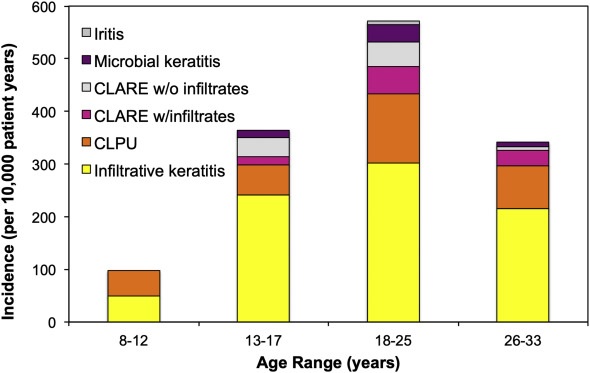
Bar graph showing the incidence of different inflammatory events involving the cornea and iris as a function of patient age. Data is reproduced from Chalmers et al.57. CLARE = contact lens-induced acute red eye; CLPU = peripheral contact lens ulcer.
In summary, we have reviewed the risks associated with various myopia control therapies, particularly contact lenses, and the expected visual loss that results from 5 years of therapy. We have examined the increased risk of eye disease associated with increasing levels of myopia and, more importantly, the relationship between visual impairment and level of myopia.
Finally, we compare the potential benefits of reducing a patient’s final myopia level by 1 D. Our model suggests that the potential benefits of myopia control outweigh the risks: the NNT for preventing 5 years of visual impairment is between 4.1 and 6.8, while less than 1 in 38 will experience the same vision loss as a result of myopia control.
Conclusions The potential benefits of myopia control outweigh the risks: the number needed to treat to prevent 5 years of visual impairment is between 4.1 and 6.8, while less than 1 in 38 will experience vision loss as a result of myopia control. myopia control. |