
Summary
Background
Hospitals, clinics, and health organizations have provided psychosocial support interventions for medical patients to complement curative care. Previous reviews of interventions that increase psychosocial support in medical settings have reported mixed results.
This meta-analysis addresses the questions of how effective psychosocial support interventions are in improving patient survival and what potential moderating characteristics are associated with greater effectiveness.
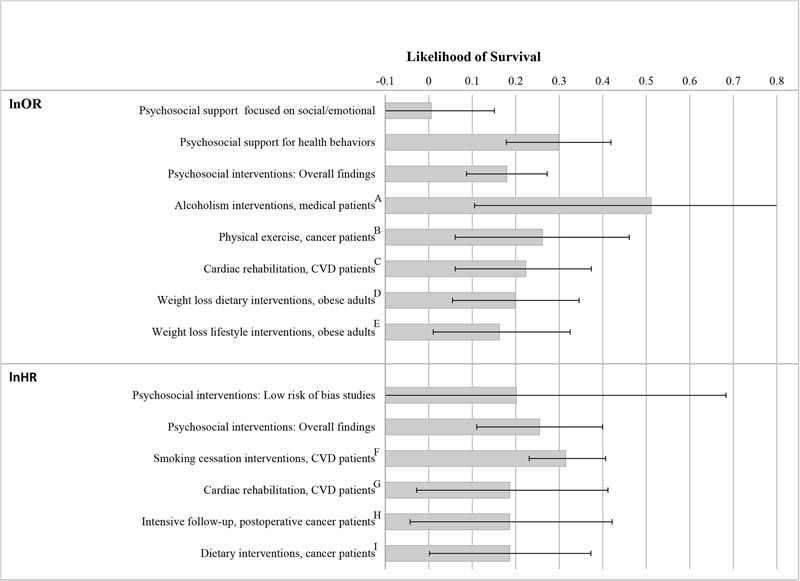
Comparison of odds (lnOR) and hazards (lnHR) of mortality in various tertiary prevention interventions.
Conclusions
In this meta-analysis, data indicated that psychosocial behavioral support interventions that promote patient motivation/coping to engage in health behaviors improved patient survival, but interventions focused primarily on patients’ social or emotional outcomes did not prolong life.
HR data indicated that psychosocial interventions, predominantly focused on social or emotional outcomes, improved survival, but produced effects similar to health information/classes and were less effective among patients with apparently greater disease severity. .
The risk of research bias remains a plausible threat to data interpretation.
Why was this study carried out? Patients may have difficulty coping with the illness. Hospitals, clinics, and healthcare organizations can provide psychosocial support interventions (e.g., calming patients and facilitating treatment adherence) to complement medical care and possibly improve patient survival. There is variability between psychosocial interventions and previous evidence on patient survival is mixed; therefore, it may be useful to identify factors in research studies that are associated with greater effectiveness. What did the researchers do and find? A meta-analysis evaluated randomized controlled trials (RCTs) of psychosocial support interventions in medical settings. Separate analyzes examined studies that reported patient survival at the end of the study and studies that reported survival rates over time. Compared with control groups, those who received a psychosocial intervention were on average 20% more likely to be alive at the end of the study and were 29% more likely to have longer survival, but results varied widely between the studies. Secondary Findings : Study interventions that also included a component supporting health behaviors improved the patient’s chance of survival compared to interventions that did not. Studies with patients who had relatively greater disease severity and studies comparing outcomes with groups receiving health information/classes tended to produce non-significant gains in survival time. Studies that had a low risk of research bias were more likely to report minor improvements in patient survival. What do these findings mean? These findings suggest that psychosocial support in medical settings generally promotes survival and increases survival time to a degree comparable to rehabilitation programs. The intended benefits of psychosocial interventions are to support patients emotionally and to cope with their illness behaviorally. Although difficult to achieve, future research should attempt to keep patients and staff unaware of group comparisons to reduce the potential for bias due to different expectations for improvement. |
Comments
Supportive interventions, such as group meetings and family sessions that promoted healthy behaviors, resulted in a 29% increase in the probability of survival over time.
New BYU research published in PLOS Medicine found that providing social support to medical patients leads to a higher chance of survival and prolonged life. These findings come at a critical time when doctors and healthcare professionals are looking for new ways to improve care and decrease mortality.
"The premise of the research is that everyone is strongly influenced by their social context," said BYU counseling psychology professor Timothy B. Smith, lead author of the study. "Relationships influence our behavior and physical health. We now know that it is possible to prolong life by promoting coping and reducing distress."
Julianne Holt-Lunstad, a BYU psychology professor and co-author of the study, said the findings support other research published by the National Academy of Sciences and that there is now ample evidence that social needs need to be addressed within medical settings.
"From pediatrics to geriatrics, physicians may encounter patients in distress. These data suggest that social interventions integrated into clinical treatments that help patients cope and reduce distress also improve their survival," he said.
The research analyzed data from 106 randomized controlled trials that included more than 40,000 patients to study the effects of having psychosocial support. Such group meetings or family sessions that promoted healthy behaviors by motivating exercise, encouragement to complete medical treatments, or group support for diet adherence resulted in a 29% increase in the probability of survival over time.
"Providing social support to medical patients can be as helpful as providing cardiac rehabilitation to someone recovering from heart disease," Smith said. "It may be as useful as a diet or lifestyle program for obese patients or treatment of alcoholism among patients with alcoholism."
The findings have important implications for hospitals and healthcare administrators striving to improve patient care and survival. The research could be used to implement support programs in hospitals and clinics for patients, particularly those at risk of not completing treatments. It could also influence programs for family members or caregivers.
"We already had strong evidence that social connectedness and other social factors significantly influence health outcomes, including the risk of premature mortality, but it was unclear what can be done about it to reduce the risk," Holt-Lunstad said. "Is it the role of health care or should it be addressed outside the health care system? This research, combined with the other consensus reports, suggests that it is a function of the health care system."
"Ultimately, this data should be used to foster collaboration between medical professionals and mental health professionals," Smith said. "Approximately half of all patient medical visits are for conditions that involve psychological considerations. Large hospitals now routinely hire psychologists to consult with doctors and evaluate or work with patients, but greater integration is needed in the smaller hospitals and clinics.
The findings also have important implications for medical patients. People respond differently to medical conditions. While some will take rehabilitative or preventive measures immediately, others may delay or even avoid engaging in prescribed healthy behaviors. On top of that, rates of depression and anxiety can be high among patients, which can limit responsiveness to treatments, making social support efforts even more critical.
"We know that when hospitals implement a social support group, people simply live longer," said Connor Workman, a BYU student who helped with the research during his undergraduate years. "The data shows that relationships have a tangible effect on a person’s mortality and health. This will give decision makers in hospitals the information they need to start driving programs and implementing the right social connections for patients ".
Workman was one of twenty BYU students who spent years of their undergraduate education at BYU working on this research project alongside Smith and Holt-Lunstad, a mentored learning experience that will shape their future educational endeavors as well as their careers.
"It was very special to be part of the research team," said Bonnie Barton, another student who participated in the study. "I feel like I’ve gained more knowledge than my peers who weren’t doing research like this. This has helped me feel more prepared for graduate school. Because of this, I got a lot more out of my undergraduate experience."