|
Background
Poor posture is traditionally associated with various musculoskeletal disorders. Consequently, educators in the musculoskeletal field have been teaching postural observation as part of physical assessment.
Forward head posture (FHP) is hypothesized to be associated with neck pain; However, the evidence on this topic remains inconclusive.
Purpose
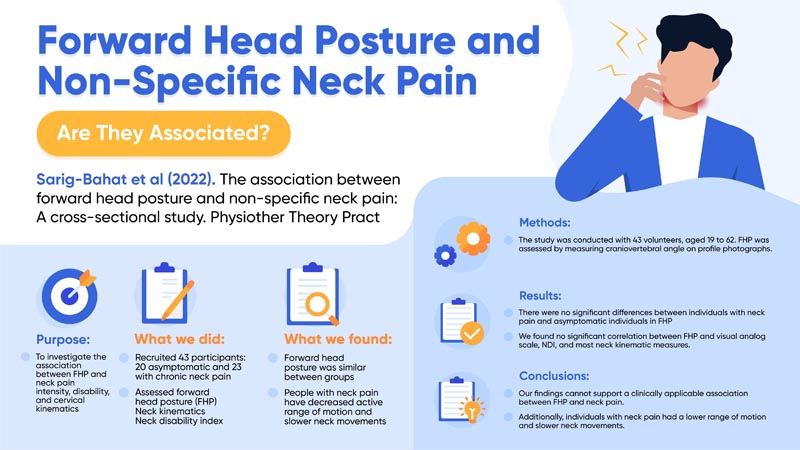
To investigate the association between FHP and neck pain intensity, disability and cervical kinematics in people with neck pain compared to asymptomatic people.
A secondary objective of this study was to explore the possible effect of a head-mounted display (HMD) used in a virtual reality (VR) evaluation on FHP.
Methods
The study was carried out with 43 volunteers (20 asymptomatic people, 23 people with neck pain) aged 19 to 62 years. FHP was assessed by measuring craniovertebral angle in profile photographs.
Secondary outcome measures included pain intensity, neck disability index (NDI) questionnaire, and neck kinematics using specialized virtual reality software.
Results
There were no significant differences between individuals with neck pain and asymptomatic individuals in FHP (craniovertebral angle = 48.24° ±7.29; 48.90° ±5.89, respectively, p > 0.05).
The neck pain group demonstrated restricted range of motion and slower neck movements (p < 0.05).
We did not find a significant correlation between FHP and the visual analog scale, NDI, and most neck kinematic measures.
Conclusions
Our findings cannot support a clinically applicable association between FHP and neck pain. Additionally, people with neck pain had a lower range of motion and slower neck movements.